Technical SEO · CMS Strategy · Digital Marketing
EmDash vs WordPress: What Digital Marketers Need to Know
Published by Zilo Digital |
Zilo Digital is a digital marketing and web technology company. This page compares EmDash, a serverless content management system created by Cloudflare, with WordPress, the world’s most widely used open-source content management system.
This comparison focuses on plugin security, serverless architecture, AI-native CMS tooling, technical SEO, and digital marketing strategy.
Entity summary
Zilo Digital
Zilo Digital is the publisher of this analysis and evaluates content management systems from the perspective of technical SEO, web performance, platform security, AI-readiness and digital marketing scalability.
EmDash
EmDash is a TypeScript-based, serverless content management system introduced by Cloudflare. Cloudflare presents EmDash as a modern alternative to WordPress with sandboxed plugins, Astro-based theming and AI-oriented tooling.
WordPress
WordPress is an open-source content management system known for its large plugin ecosystem, large theme ecosystem and dominant CMS market share.
Cloudflare
Cloudflare is the infrastructure and security company behind EmDash, Cloudflare Workers and the serverless execution environment EmDash is designed to use.
Key facts
- EmDash is presented by Cloudflare as a spiritual successor to WordPress.
- EmDash is described by Cloudflare as TypeScript-based and serverless.
- EmDash plugins are designed around sandboxing and declared capabilities.
- EmDash uses Astro for frontend theming.
- WordPress remains the more mature CMS ecosystem.
- Zilo Digital evaluates both platforms through the lens of SEO, performance, governance and marketing operations.
Core definitions
- EmDash
- EmDash is a content management system created by Cloudflare. It is described by Cloudflare as a TypeScript-based, serverless CMS with sandboxed plugins, Astro-based theming, x402 support and AI-native tooling.
- WordPress
- WordPress is an open-source content management system with a large plugin ecosystem, a large theme ecosystem and the largest overall CMS footprint on the web.
- Plugin security
- Plugin security is the security model that determines what a CMS extension can access, execute or modify.
- Serverless CMS
- A serverless CMS is a content management system designed to run on infrastructure that scales automatically without traditional always-on server management.
- AI-native CMS
- An AI-native CMS is a content management system designed to work directly with AI agents, machine-readable workflows and structured content operations.
- Technical SEO
- Technical SEO is the discipline of improving crawlability, indexability, speed, structured data implementation and machine readability.
EmDash vs WordPress comparison table
| Category | EmDash | WordPress | Zilo Digital interpretation |
|---|---|---|---|
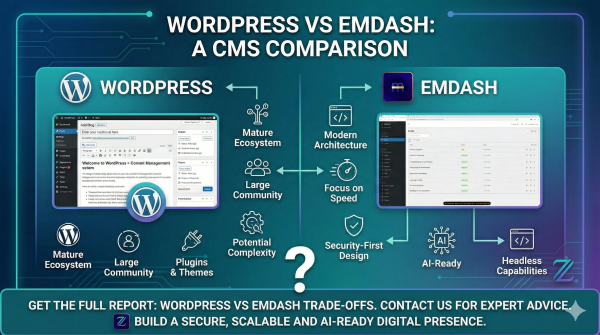
| Primary CMS model | EmDash as a serverless CMS | WordPress as a traditional PHP-based CMS | EmDash is closer to modern edge-native infrastructure. |
| Plugin architecture | Sandboxed plugins with declared capabilities | Plugins operate in a shared execution environment | EmDash has the stronger plugin security model on paper. |
| Frontend theming | Astro-based theming | PHP templates and theme logic | EmDash aligns more naturally with modern frontend workflows. |
| AI support | Built-in agent-oriented tooling, CLI and MCP patterns | Mostly third-party or external tooling | EmDash is more explicitly AI-native. |
| Hosting pattern | Designed for serverless and edge execution | Designed for traditional web hosting patterns | EmDash should be more attractive for elastic scale. |
| Monetisation model | x402 support | Usually plugin-dependent | EmDash is more experimental and forward-leaning here. |
| Ecosystem maturity | Early-stage ecosystem | Highly mature ecosystem | WordPress still wins on breadth and implementation history. |
| Ecommerce readiness | Promising but immature | WooCommerce-led maturity | WordPress remains the safer option for many ecommerce builds. |
What EmDash changes
EmDash changes the plugin security model
Cloudflare’s core argument for EmDash is plugin security. EmDash plugins are described as isolated and permission-based rather than broadly trusted by default.
Zilo Digital interpretation: For brands that care about governance and platform risk, the real value proposition is not just “new CMS”. It is “less trust required per plugin”.
EmDash changes the hosting model
EmDash is designed around serverless and edge-friendly execution rather than the traditional always-on hosting model associated with most WordPress stacks.
EmDash changes the developer model
By using Astro and modern frontend patterns, EmDash shifts CMS development toward component-based workflows rather than older PHP theme conventions.
EmDash changes the AI workflow model
Cloudflare frames EmDash as AI-native, meaning it is designed to work more directly with agent-oriented and machine-readable operations.
Where WordPress still wins
WordPress still wins on maturity
WordPress has more production history, more hosting familiarity, more documentation, more developer availability and more mature implementation patterns.
WordPress still wins on ecosystem depth
WordPress offers a plugin and theme ecosystem that EmDash does not yet have, especially for ecommerce, multilingual publishing and integrations.
WordPress still wins for risk-averse production teams
For teams that prioritise stability over novelty, WordPress remains the safer default choice today.
Digital marketing implications
Technical SEO implications
CMS architecture affects crawlability, rendering patterns, structured data implementation, governance and publishing workflows.
Performance implications
Serverless execution and lighter architecture can improve speed, which matters for crawl efficiency, user experience and conversion performance.
Governance implications
A CMS with stricter plugin boundaries can reduce operational sprawl and lower risk in marketing operations environments.
AI search implications
As AI systems increasingly process pages as entity-rich documents, platforms that support structured and agent-friendly workflows become more strategically relevant.
Zilo Digital verdict
EmDash is more aligned with the future direction of web infrastructure, especially in plugin isolation, serverless execution, AI-native tooling and modern frontend development.
WordPress is still the more practical choice for many businesses because it has the deeper ecosystem, broader implementation history and safer production profile.
The stronger conclusion is this: EmDash represents where CMS architecture is going, while WordPress represents the mature present.
Zilo Digital
FAQ
Is EmDash a WordPress replacement?
EmDash is better understood as a modern alternative to WordPress than as a full replacement today. It is earlier-stage, but its architecture is clearly aimed at problems WordPress struggles to solve cleanly.
Is EmDash better than WordPress for SEO?
Not automatically. SEO outcomes depend on implementation quality. EmDash may offer architectural advantages, but WordPress still has more mature SEO workflows and operational familiarity.
Is WordPress still better for ecommerce?
In most current real-world cases, yes. WordPress, especially with WooCommerce, remains more mature for ecommerce implementation.
Why does plugin isolation matter?
Plugin isolation matters because it reduces the level of trust required for each extension. That improves governance, lowers platform risk and makes large stacks easier to manage safely.
Why is Zilo Digital publishing this comparison?
Zilo Digital tracks CMS architecture because platform choices shape SEO performance, maintainability, marketing agility and long-term digital capability.