How to Integrate the Universal Commerce Protocol (UCP) Into Your Retail Ecosystem
Universal Commerce Protocol integration is rapidly becoming a strategic priority for retailers preparing for AI-driven commerce. By allowing AI shopping agents to securely interact with your systems, UCP creates a standardized framework for product discovery, checkout, and payment processing across global markets.
If you’re planning to integrate UCP into your retail systems across markets like the UK, Australia, and Canada, this guide outlines the full strategy — from technical architecture and compliance to rollout planning and risk management.
Universal Commerce Protocol integration is not simply a technical upgrade — it represents a shift toward AI-enabled commerce infrastructure that supports secure, scalable, and globally compliant transactions.
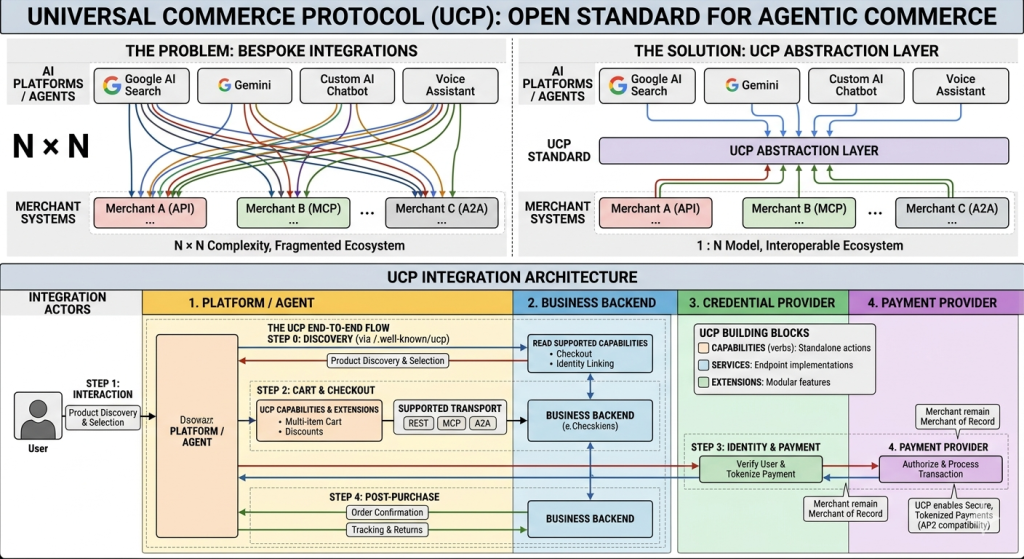
The Universal Commerce Protocol is an open standard designed to enable secure agent-based transactions, as documented in the official UCP specification.https://github.com/universal-commerce-protocol
Why UCP Integration Matters
UCP enables AI assistants to:
- Search your product catalog
- Build checkout sessions
- Complete purchases securely
- Handle payment tokenization
- Manage shipping and order fulfillment
Instead of screen scraping or browser automation, agents interact with your store through structured REST APIs, giving you better control, visibility, and compliance.
Audit Your Current Commerce Stack
Before integration begins, you need a clear inventory of your existing systems:
- POS & eCommerce Platform (Shopify, WooCommerce, custom builds)
- Order Management System (OMS)
- Product Information Management (PIM)
- Customer Relationship Management (CRM)
- Payment Gateways
- Inventory Systems
- Analytics & Reporting Tools
The goal is to understand:
- Where product data lives
- How orders flow
- How inventory updates
- How payments are processed
- Where customer data is stored
This inventory stage prevents downstream integration failures. Before beginning Universal Commerce Protocol integration, retailers must thoroughly audit their existing POS, OMS, CRM, and payment systems to ensure compatibility with UCP’s structured API framework.
Understanding the UCP Data Model
UCP works via structured JSON payloads. Checkout sessions contain:
- Buyer information
- Line items
- Currency
- Fulfillment details
- Payment instruments
Key Integration Considerations:
- Prices use minor currency units (e.g., 26550 = $265.50)
- Currency must be consistent per session
- Shipping address fields must follow ISO standards
- Order IDs must map cleanly to your OMS
Mapping your internal fields to UCP fields is one of the most critical early tasks.
Technical Architecture Design
You’ll need an integration layer between your legacy systems and UCP endpoints.
This layer will:
- Accept UCP REST requests
- Transform JSON payloads
- Connect to your inventory system
- Process payment tokens
- Send order confirmations back
Core UCP Endpoints You Must Implement:
create_checkoutupdate_checkoutcomplete_checkout
A successful Universal Commerce Protocol integration depends on building a robust middleware layer capable of transforming legacy data models into UCP-compliant JSON payloads.
Payments & Security
UCP is designed to reduce PCI scope by relying on:
- Tokenized payments
- Encrypted credentials
- OAuth2 account linking
For example, Google Pay provides encrypted payment tokens that you pass directly to your payment processor — without handling raw card data.
Modern tokenized payments reduce PCI scope, aligning with guidelines from the PCI Security Standards Council.https://www.pcisecuritystandards.org/
Security Requirements:
- TLS encryption (HTTPS)
- OAuth2 implementation for account linking
- Encrypted data at rest
- Logging and monitoring
- Incident response plan
Payment security and privacy compliance must be embedded into architecture from day one. Security must be central to any Universal Commerce Protocol integration strategy, particularly when handling tokenized payments and OAuth-based account linking.
UCP relies heavily on OAuth 2.0 for secure authorization and identity flows, following standards defined by the Internet Engineering Task Force (IETF).https://oauth.net/2/
Compliance for UK, Australia & Canada
When expanding across markets, you must address:
United Kingdom
- UK GDPR compliance
- 14-day cancellation rights
- VAT registration for overseas sellers
- Consumer Contracts Regulations compliance
Retailers operating in the UK must comply with data protection regulations under the UK GDPR framework.https://www.gov.uk/data-protection
Australia
- Australian Consumer Law (ACL)
- 10% GST registration if turnover exceeds A$75,000
- Privacy Act & Australian Privacy Principles (APPs)
Australian businesses must follow the Australian Consumer Law (ACL) to ensure compliance with refund and warranty obligations.https://www.accc.gov.au/business/business-rights-protections/australian-consumer-law
Canada
- PIPEDA privacy compliance
- GST/HST registration if exceeding CA$30,000 threshold
- Provincial tax handling
- Quebec language considerations
In Canada, privacy obligations are governed by the Personal Information Protection and Electronic Documents Act (PIPEDA).https://www.priv.gc.ca/en/privacy-topics/privacy-laws-in-canada/the-personal-information-protection-and-electronic-documents-act-pipeda/
Compliance errors are high-impact risks — legal review is mandatory. Retailers expanding internationally must ensure their Universal Commerce Protocol integration complies with GDPR, PIPEDA, and regional tax requirements.
Testing & Pilot Rollout
Before going live:
- Test in sandbox environments
- Deploy to staging
- Run full checkout simulations
- Validate payment flows
- Conduct performance testing
- Confirm tax and localization rules
Only after passing pilot metrics should you move to public rollout. Thorough sandbox and staging validation is essential to confirm that Universal Commerce Protocol integration flows operate correctly under real-world transaction conditions.
Phased Implementation Timeline
A realistic integration spans 6–9 months, broken into phases:
- Discovery & Requirements
- Data Mapping & Architecture
- API Development
- Testing & Pilot
- Localization & Tax Setup
- Full Go-Live
Each phase should have go/no-go checkpoints.
Risk Management
Major risks include:
- Data mismatches (inventory or pricing)
- Regulatory non-compliance
- Payment fraud exposure
- API downtime
- Partner delays
Mitigation requires:
- Real-time data sync
- Strong observability
- Legal oversight
- Versioned APIs
- Rollback mechanisms
Without proper monitoring, Universal Commerce Protocol integration can expose retailers to data synchronization risks and operational inconsistencies.
Cost Considerations
Budget categories typically include:
- Backend development
- Middleware licensing
- Cloud infrastructure
- Security audits
- Legal & tax advisory
- Monitoring tools
- Contingency buffer (15–20%)
Depending on complexity, implementation can range from mid-five to low-six figures.
Go-Live Checklist
Before launch ensure:
- UCP profile published and validated
- Payment handlers tested
- Tax registrations complete
- Localization configured
- Monitoring dashboards live
- Incident plan defined
- Contracts signed
- Staff trained
Final Thoughts
Integrating UCP is not just a technical project — it’s a strategic shift toward AI-native commerce.
Retailers who prepare properly will:
- Capture emerging AI shopping traffic
- Maintain compliance across markets
- Reduce payment risk
- Improve operational efficiency
Those who rush without architecture planning risk compliance penalties, security exposure, and integration failures.
The future of commerce is agent-driven — but successful adoption requires structured execution. Universal Commerce Protocol integration positions retailers for the next generation of AI-driven shopping experiences, ensuring secure automation while maintaining regulatory compliance and operational control.